
You've been warned | Crypto & Debt
How a rapidly growing shadow money-market complex now sits between U.S. debt and crypto liquidity — effectively killing DeFi’s decentralization promise.

You’ve been warned.
Centralized Finance; U.S. Treasuries, USDT, Stablecoins, Bitfinex, and the 0% Bitcoin Loans
Before reading this letter, make sure to read "The GENIUS Act” letter for greater context. You are now entering the wall street jungle. Hang tight.
https://commodis.substack.com/p/the-genius-act
Hi guys,
First, I want to let you know that I’ve been occupied recently due to a family matter that required my attention. This has led to less activity in the Discord forum. I appreciate your understanding.
On a separate note, there has been a fun wave of selling across both the technology and crypto sectors lately. I would like to take this moment to further underscore the ongoing structural misconduct and deception within our financial system, particularly as it relates to the deteriorating debt framework — and the role crypto now plays within it.

Interestingly, crypto and stablecoins are now seemingly fulfilling their destiny — the end stage, where crypto becomes a vessel for U.S. debt and Treasury liquidity. Tether (USDT) is now a top-20 sovereign-scale holder of U.S. Treasury bills, coming perfectly to Scott Bessent’s aid. Even more eye-opening, a strategy central to Tether’s financial engineering is playing out via Bitfinex; a 0% Bitcoin loan program that subsidizes leverage across the crypto market.
And who is managing this large portion of Tether’s treasury holdings? Cantor Fitzgerald and the Lutnick family.
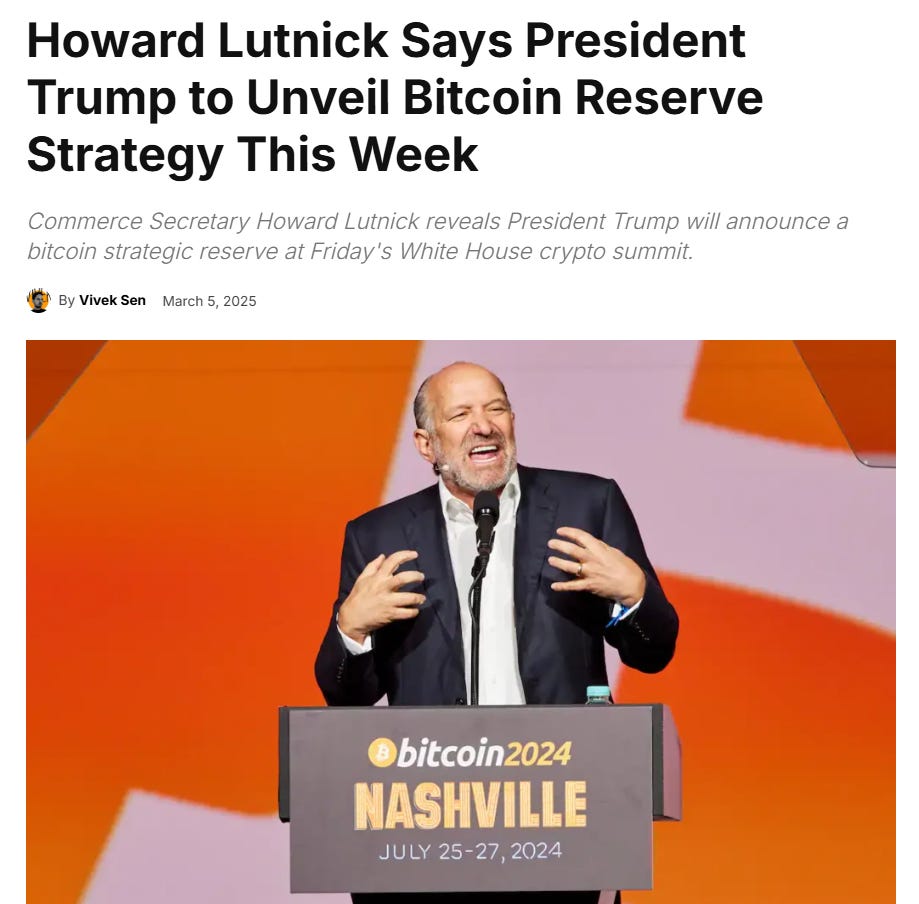
Note; Be carefull with accounts like Vivek Sen. Narrative accounts.

This is a comprehensive and a stark informational letter. Please take your time. The subject demands the highest level of attention, yet the complexity of our monetary system requires equally thorough examination and analysis. Before proceeding, allow me to outline a few key points;
Tether & USDT market, Crypto and Debt
Tether Limited is owned by iFinex, a company based in the British Virgin Islands. An offshore financial hub with privacy, encouring tax policies and soft regulations.
Tether is a company that issues the USDT stablecoin, a type of cryptocurrency designed to have a stable value by being pegged to the U.S. dollar. Founded in 2014, Tether Limited is the private company behind the token, which aims to maintain a 1:1 value with the USD through asset reserves. USDT is widely used in the cryptocurrency market for its role in providing liquidity and acting as a bridge between traditional and digital currencies. USDT is the world’s largest stablecoin by market capitalization.
For every USDT token issued, Tether claims to hold an equivalent amount of U.S. dollars in reserve assets, though its reserve composition has been a subject of controversy and regulatory scrutiny.
Tether’s reserves are not just dollars in a bank. USDT has evolved into a gigantic offshore money-market fund, with the bulk of its reserves in short-term U.S. Treasury bills.
Cantor Fitzgerald and the Lutnicks are deeply involved. A majority of Tether’s $135 billion in Treasuries are now reportedly managed through Cantor Fitzgerald — a firm led by the politically connected Lutnick family — simultaneously U.S. political power-players, major Treasury brokers, and backers of a multibillion-dollar Bitcoin venture. What a combination.
Bitfinex fuels the system with free leverage. Tether’s sister company, the Bitfinex exchange, offers a Bitfinex Borrow program that issues 0% interest Bitcoin loans and ultra-cheap USDT-based margin. These free loans enable cross-exchange arbitrage and carry trades that inflate crypto trading volumes and indirectly fuel risk-taking in equities.
Regulators have caught Tether lying in the past. Investigations by the New York Attorney General and CFTC found that Tether misrepresented its reserves, commingled funds with Bitfinex, and was often far from fully backed. They’ve paid fines, but notably no full audit of Tether has ever been completed. Known audit firms for the “Big 4” (big four banks U.S.) refuses to sign for Tether.
Despite trust issues, USDT is now systemically important. Faster than people could blink, Tether has now grown into one of the largest holders of U.S. Treasuries in the world — a top-20 holder (17), exceeding many sovereign nations. This gives Tether and USDT significant influence on both crypto liquidity and short-term U.S. debt markets.
The U.S. isn’t shutting Tether down — it’s co-opting it. Tether is rolling out a U.S.-compliant stablecoin (USAT) and deepening its ties with U.S. institutions. Rather than cracking down, regulators appear to be domesticating Tether into an overseas dollar-liquidity vehicle.
If this machine breaks, the fallout will be immense. A collapse or run on USDT would first slam Bitcoin, then ripple into high-beta tech stocks and even U.S. short-term funding markets. Due to the gigantic sizee it has reached in such a short time, it would be a “shadow” liquidity withdrawal with serious systemic consequences.
The Network
To understand this USDT–Bitfinex–Cantor chain, we need to know the players involved. A small set of individuals and entities sit at the center of this shadow financial complex;
Tether (Tether Holdings Ltd.) — Founded in 2014, Tether issues USDT, the largest stablecoin in the world (recently around $185 billion in circulation with $135 billion in T-Bills), and has announced a U.S.-regulated sibling coin (USAT). Tether was originally marketed as “digital dollars” fully backed by cash in a bank, but over time it morphed into something much larger. The company’s key figures include CTO-turned-CEO Paolo Ardoino, who has become politically connected (even obtaining citizenship in Bitcoin-friendly El Salvador), and CFO Giancarlo Devasini, a controversial billionaire co-founder with a colorful past (from a software piracy lawsuit to failed medical ventures). Colorful past is a must of course. Another long-time executive, JL van der Velde, links the leadership teams of Tether and Bitfinex. Notably, Tether and Bitfinex share executives, shareholders, and even lawyers, blurring any lines between the stablecoin issuer and the crypto exchange.
Bitfinex (iFinex Inc.) — One of the oldest crypto exchanges, Bitfinex operates through various offshore jurisdictions and has a history entwined with Tether. In fact, they are sister companies that share personnel and owners. Bitfinex is central to Tether’s financial engineering. Through its Bitfinex Borrow program, the exchange issues 0% interest loans in Bitcoin and offers dirt-cheap leverage on trades denominated in USDT. This is essentially a subsidized leverage factory (I’ll explain shortly why they can hand out free BTC loans). Bitfinex has faced regulatory trouble before — the CFTC and the New York Attorney General (NYAG) fined Bitfinex for misleading clients, hiding an $850M loss, commingling customer funds with Tether, and other infractions. Shady layers upon shady layers. Despite those run-ins, Bitfinex remains a major venue and a testing ground for Tether’s liquidity maneuvers.
Cantor Fitzgerald & The Lutnicks — Cantor Fitzgerald is a prominent Wall Street brokerage and a primary dealer in U.S. Treasuries. It might seem like an unlikely character in a crypto drama, but Cantor now manages a huge share of Tether’s U.S. Treasury holdings. This links the heart of the crypto offshore dollar system (USDT) directly to the heart of traditional U.S. finance. At the center is Howard Lutnick, the U.S. Secretary of Commerce, Cantor’s long-time CEO/chairman and a player in U.S. political and financial circles. Lutnick has publicly defended Tether’s reserve practices (of course he did). His involvement as both a corporate financier and government official provides Tether with a veneer of legitimacy and a direct line into U.S. markets and government. Meanwhile, Howard’s son Brandon Lutnick has emerged as a key crypto dealmaker — he’s spearheading a multibillion-dollar Bitcoin investment venture called 21 Capital (backed by Cantor, Tether/Bitfinex, and SoftBank). In other words, the Lutnicks have positioned Cantor at the crossroads of the U.S. Treasury market and the crypto-stablecoin market.
El Salvador – A Political Safe Haven — Facing ongoing scrutiny in the U.S. and elsewhere, Tether has strategically shifted parts of its operations to El Salvador. El Salvador’s government under President Bukele is openly Bitcoin-maximalist and provides a friendly jurisdiction for crypto businesses. Tether obtained a digital asset license there, and Bitfinex Securities (an affiliate for issuing tokenized stocks/bonds) is also licensed in El Salvador. Paolo Ardoino’s Salvadoran citizenship and work on government-backed Bitcoin mining and energy projects further strengthen this alliance. Essentially, El Salvador offers Tether/Bitfinex a regulatory sanctuary — a sovereign jurisdiction aligned with their interests and outside the direct reach of standard U.S. or EU regulators.
USAT – The Onshore, Compliant Sibling — In 2025, Tether announced plans for USAT, a fully U.S.-regulated stablecoin intended to operate alongside USDT. This new coin is designed to meet ‘strict’ U.S. regulatory standards (so-called “permitted issuer” criteria), meaning it would be backed by high-quality reserves held with transparent custodians and subject to real oversight. (high quality reserves means U.S. credit. In other words, it’s junk reverses.) USAT is not meant to replace USDT but to run in parallel — essentially creating twin liquidity pipelines; one offshore (USDT) and one onshore (USAT). The timing is telling; USAT’s development coincides with a push for U.S. stablecoin legislation. Tether even hired a former U.S. political advisor (Bo Hines from the Trump camp) to help navigate policy. All signs suggest that instead of shutting Tether down, U.S. regulators is co-opting it — bringing part of its operations under the official umbrella, while letting the original USDT continue to function as an offshore dollar pump. This soft approach implies that the playbook is as straightforward as we have been expecting; domesticate the golden-goose of crypto liquidity while morphing that liquidity to prop up the debt system. It is a remarkably sophisticated play aimed at younger, right-leaning, pro-crypto demographics.
When the government is in desperate need of financing, and they can not obtain financing this way;
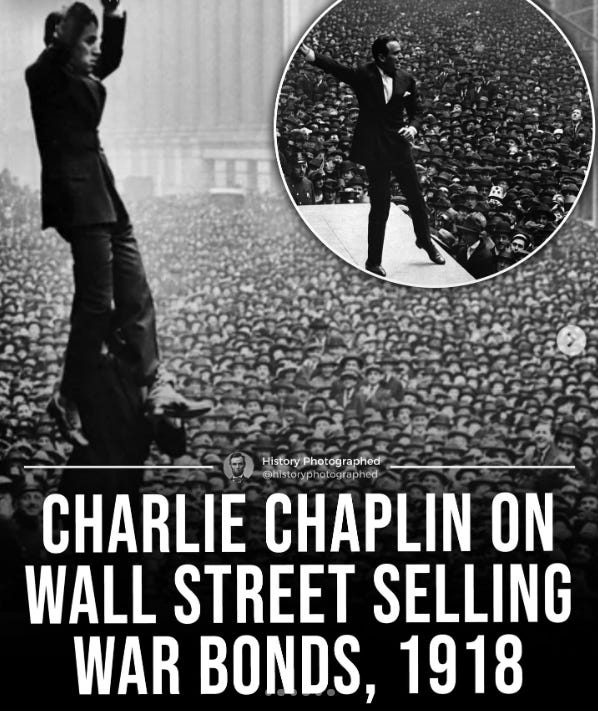
Instead, you design something far more appealing — an instrument that a significant share of individuals aged 15 to 40 are not merely willing to purchase, but actively eager to embrace. The irony is striking; persuade them to champion the very system they believe they are disrupting. This saddens me. A coordinated campaign directed at the very generations, young and gullible, now expected to shoulder the burden of artificially low rates running for decades, a deteriorating debt system, aggressive currency devalution and an increasingly costly wave of retirees → the bill due 2050.
What Actually Backs USDT?
Tether’s public line has always been that each USDT token is backed 1-to-1 by a U.S. dollar or equivalent asset. The reality of USDT’s reserves, however, has been a moving target — and often a far cry from “dollars in a bank account.” Over the years, what backs USDT has shifted from cash, to commercial paper, to loans, to now mostly U.S. Treasuries. Let’s unpack the truth behind Tether’s reserves and why it matters;
Regulators Caught Tether Misrepresenting Reserves. In 2021, after a lengthy investigation, the New York Attorney General (NYAG) found that Tether had lied about its backing. When Bitfinex (Tether’s sister exchange) lost $850 million of client funds to a shady payment processor, Tether quietly loaned Bitfinex its reserve cash to cover the shortfall – meaning for a period, a lot of USDT in circulation was not fully backed by reserves. Public claims that USDT was always “1:1 backed” were false. Tether and Bitfinex settled with NYAG for $18.5 million, and in the settlement they neither admitted nor denied wrongdoing but were forced to release quarterly reserve statements and bar New York customers. That same year, the Commodity Futures Trading Commission (CFTC) fined Tether $41 million for making misleading statements about its reserves. The CFTC revealed that between 2016 and 2018, Tether held full fiat reserves for USDT only 27.6% of the time. In other words, for most of that period, they did not have one dollar in the bank for every token — contrary to their assurances. Much of the backing was held in riskier assets like unsecured loans or commercial paper. These findings confirmed what skeptics had long suspected; Tether was, in effect, operating as a fractional-reserve institution. (In other words, they too employ a fractional-reserve model.)
No Full Audit, Ever. Despite years of promises, Tether has never undergone a full independent audit of its reserves. They have only provided attestations, which are snapshots of assets and liabilities at a point in time, typically produced by a small accounting firm. Major auditors (for the Big Four) reportedly won’t touch Tether. Even Tether’s general counsel has admitted that an audit of the scale and type people want is not possible under current conditions. This lack of a rigorous audit means we must largely trust Tether’s and U.S. gov words (and the limited regulator settlements) about what backs USDT. That remains a huge red flag for many observers.
Today’s Reserves; A U.S. Treasury Monster. Based on Tether’s own reports, as of late 2024 and 2025, the composition of USDT’s reserves has dramatically shifted into short-term U.S. government debt. Tether holds on the order of $135–150 billion in U.S. Treasury bills (T-bills), making up the vast majority of its backing. The remaining reserves are a mix of cash & bank deposits, some gold, some Bitcoin, secured loans, and equity investments (including in crypto startups, crypto mining operations, and AI firms). In effect, Tether has become a giant offshore money-market fund, issuing crypto-dollar tokens (USDT) that are collateralized primarily by U.S. Treasuries. USDT isn’t exactly “backed by dollars” in a vault; it’s backed by Treasury bills that mature in a few months. In fact, Tether Ltd. has grown into one of the world’s top 20 holders of U.S. Treasuries — putting it above many nation-states in terms of U.S. debt holdings. This is a staggering transformation; a crypto company, once dismissed as a fringe operation, is now a significant player in financing the U.S. government’s short-term debt.
What are the implications of this reserve structure? On one hand, short-term Treasuries are considered very safe, highly liquid assets — far safer than the opaque commercial paper Tether used to hold. In that sense, USDT is arguably more robust than it was in the past. But this is only if you take the viewpoint that the fiat currency is safe. As we know, the fiat currency is not safe. Furthermore on the other hand, it means crypto markets and U.S. government debt are now entwined. USDT underpins almost every crypto trading pair, margin system, and liquidity pool. If Tether sneezes, the Treasury market could catch a cold, and vice versa. Tether has essentially hitched the stability of the entire crypto ecosystem to the stability of U.S. government debt (and to the smooth functioning of its relationship with Cantor Fitzgerald and the U.S. banking system needed to hold and trade those T-bills).
Bitfinex Borrow and the 0% BTC Loan Engine
One of the most peculiar features of this system is Bitfinex’s ability to offer 0% interest loans in Bitcoin through its Bitfinex Borrow program. In a normal world, no one lends a high priced asset like BTC for free — unless there’s an ulterior motive. So why does Bitfinex dangle essentially free Bitcoin to traders? Because it supercharges the whole Tether engine. Here’s how this subsidized leverage factory works and why it matters;
Interest-Free Bitcoin, Courtesy of Tether. Bitfinex allows certain customers to borrow Bitcoin at 0% interest (typically for 30–120 days) if they post collateral like USDT, USD, or other approved assets. In practice, this means a trader can get, say, 100 BTC from Bitfinex, use their USDT as collateral, and not pay a penny in interest for months. It sounds unbelievably generous. But remember, Tether (via Bitfinex) isn’t primarily trying to earn yield from the loan itself — its real profits come from the yield on the T-bills that were bought when that USDT was originally issued. Because Tether is raking in billions from its Treasury holdings, it can afford to subsidize crypto market liquidity by offering free or ultra-cheap leverage. The goal is to stimulate trading activity and demand for USDT, which in turn leads to more USDT issuance (and more T-bill purchases by Tether!).
Synthetic Leverage and Arbitrage — The 0% BTC loans feed a whole ecosystem of cross-exchange trades. For example, a trader can borrow Bitcoin on Bitfinex at no cost, then transfer that BTC to another exchange and use it in various strategies; opening a long position on a Bitcoin perpetual swap (to capture funding payments), or arbitraging price differences between exchanges, or providing liquidity in a yield-bearing platform. The trader effectively gets “free” capital (in BTC) to deploy elsewhere. Meanwhile, they might pay a small fee or interest on the other exchange, but if the trade yields more than that (which, in times of market volatility or bullish sentiment, it often can), it’s essentially free money for the trader. This is a classic carry trade; borrow cheap in one place, lend or invest at higher rates elsewhere.
To illustrate, here’s a simplified sequence of how these 0% loans fuel the market;
Borrow BTC at 0% on Bitfinex; A trader posts collateral (e.g. USDT) on Bitfinex and takes out a Bitcoin loan with zero interest.
Move the BTC to another venue; The trader transfers the borrowed BTC to another exchange or platform where opportunities beckon.
Open leveraged positions or arbitrage trades; On the second platform, the trader can use the BTC to open long positions on BTC futures or perpetual swaps (especially if those pay positive funding to long traders), or engage in arbitrage (like spot-futures price discrepancies, aka basis trades), or even just earn yield by lending that BTC out if rates are attractive. In any case, the trader is using the free coin to extract profit from some market inefficiency.
Profit from the spread; The trader gains from the yield or price spread on the second platform, while Bitfinex/Tether earns yield on the original collateral (the USDT that was issued and then parked in Treasuries). Both the trader and Tether effectively win, funded by the broader market and, indirectly, by Uncle Sam’s interest payments on those T-bills. Brrrrrr.
Why it Matters; This arrangement keeps crypto liquidity artificially high. By offering free BTC loans, Bitfinex encourages traders to keep borrowing and trading, which props up volumes and open interest across exchanges. It also solidifies USDT as the preferred collateral and trading pair for much of the crypto market. If you can easily get a free BTC loan with USDT as collateral, you have a strong incentive to acquire or hold USDT. That boosts demand for USDT, leading to more USDT being minted, which means Tether buys more Treasuries with the dollars it receives — and earns even more yield to continue funding this cycle. It’s a self-reinforcing loop; free leverage → more trading → more USDT usage → more treasury demand → more Tether profits → capacity for more free leverage. Crypto investors happy. United States Gov happy. The result is a synthetic pump under crypto markets. Prices and volumes are higher than they would be in a more organically funded system. Bitcoin and other assets get an indirect boost, and even U.S. equities (particularly high-risk, high-beta stocks) can feel the effects, as crypto gains often spill into risk-taking elsewhere. This is why we say Tether’s operations indirectly fuel risk-on behavior in U.S. equities — it’s all connected by the flow of easy money.
The Move to El Salvador and the U.S. “Soft Co-Opt”
Facing increased scrutiny in traditional financial hubs, Tether made a savvy move; shifting parts of its base of operations and regulatory domicile to El Salvador. This tiny Central American nation is an outlier in global finance — it’s the first country to adopt Bitcoin as legal tender, and its leadership is openly opposing other regulators’ negative stance on crypto. By embedding itself in El Salvador, Tether gains a kind of political shield.
On Salvadoran soil, Tether enjoys a government that sees eye-to-eye with its “Bitcoin fixes everything” ethos. The company obtained a digital asset license under El Salvador’s new pro-crypto regulations, and set up local entities for Tether and Bitfinex’s various arms (like Bitfinex Securities). By doing so, Tether places a portion of its operations firmly outside the direct reach of U.S. and EU regulators. It’s much harder for the NYAG or the U.S. Department of Justice to exert pressure on a company that your buddy the President of El Salvador is proudly protecting. And El Salvador benefits too; it attracts investment and tech infrastructure (Tether has invested in Bitcoin mining and energy projects there) and garners a reputation as a global crypto hub.
However, the El Salvador move is only half of the equation. The other half is happening back in the United States, not in the shadows but right under the regulators’ noses. Instead of aggressively cracking down on Tether, U.S. institutions appear to be integrating with it. Cantor Fitzgerald now manages a huge chunk of Tether’s reserves (meaning a Wall Street firm is custodian for $100 billion belonging to a company previously accused of fraud by NY authorities). Howard Lutnick, with his deep ties to U.S. political and financial elite, is publicly vouching for Tether. His son is leading a crypto venture intertwined with Tether and even Donald Trump’s circle has connections here (Lutnick senior joined the Trump administration; Trump himself has called himself “the crypto president” who likes what crypto can do for the dollar. Most people will misunderstand what Trump actually ment here). Tether has also timed its USAT (U.S. stablecoin) initiative with the U.S. Congress’s efforts to regulate stablecoins, essentially saying; “We can be compliant if you let us in the club.”
All this suggests a grand bargain in the making. Instead of hammering Tether down for past sins, the powers in the U.S. are taking a more pragmatic approach; co-opt Tether’s machinery for U.S. benefit. After all, Tether’s massive Treasury purchases help finance the U.S. deficit. The crypto liquidity it provides keeps markets buoyant. And a compliant onshore stablecoin could bring parts of that $190 billion under U.S. oversight without killing the golden goose that is offshore USDT demand. In short, it’s looking less like “destroy Tether, it’s a risk” and more like “embrace Tether, make sure we control the important pieces.” This is what we mean by a “soft co-opt”. The U.S. isn’t openly endorsing Tether, but through Cantor and regulatory forbearance it’s effectively bringing Tether into the fold. We have already openly endorsed stablecoins via the GENIUS Act, and Tether is one of the tools they intend to use.
It’s a clever equilibrium; Tether continues operating and expanding offshore (now with a friendly base in El Salvador), largely unimpeded. Meanwhile, a parallel fully-regulated stablecoin (USAT) is set up to satisfy domestic rules. Cantor bridges the two worlds by handling the assets, and the U.S. gets a hidden hand on the levers of an otherwise unregulated global dollar pool that is growing in a rapid pace. This kind of arrangement might have seemed far-fetched a few years ago, but given Tether’s scale today, and the desperation from the United States government to save the Treasury market — it should be a path with less resistance from regulatory altercations. More like a forced push.
How the Machine Prints Money
Let’s step back and look at the bigger picture of Tether’s business model. Stripped to its core, Tether is running a highly lucrative “shadow bank” that prints its own dollars (USDT) and parks the proceeds in government debt. It’s like having a license to mint money, as long as people keep using your token. Here’s the cycle, step by step;
Dollars In → USDT (or USAT) Out; New money comes into the system from exchanges, traders, OTC desks, and institutions wanting stablecoins. These parties hand over real dollars or other assets to Tether Ltd. In exchange, Tether mints new USDT (for offshore clients) or, in the future, USAT (for U.S.-regulated onshore clients). This is effectively printing dollar-liquivalent tokens against an inflow of capital. For example, if a big investor wires $500 million to Tether, they receive roughly 500 million USDT newly created.
Reserves Go Into U.S. Treasuries; Tether doesn’t let that $500 million sit idle. Almost immediately, it uses the cash to purchase ‘high-quality’ liquid assets, mainly short-term U.S. Treasury bills (high quality!). Through Cantor Fitzgerald (its broker/manager), Tether buys, say, 3-month T-bills which are backed by the full faith and credit of the U.S. government. Essentially, Tether takes the dollars from investors and lends them to the U.S. government by buying its debt. At the scale Tether now operates, this has made them one of the biggest single players in that market.
Yield = Pure Profit; Tether then earns interest on those T-bills. With yields in the 5% range over the past year, this is a massive income stream. Every year, billions of dollars in interest flow into Tether’s coffers courtesy of Uncle Sam. For rough math; $100 billion in Treasuries at 5% yields $5 billion per year. Tether’s latest financial reports for 2025 indicate they’ve generated over $10 billion in net profit this year alone — an astounding number that would make many actual banks jealous. And unlike a traditional bank, Tether doesn’t have an expensive branch network or heavy regulatory capital requirements. This is arguably the most profitable carry trade in crypto; raise funds at 0% (people give you dollars for your tokens), invest in ‘risk-free’ government debt at 5%, and pocket the spread, now you can reinvest even more supporting U.S. treasuries. (Yes, it is basically the same principle as we are already doing but modified to capture crypto flows to support the treasury system.)
Use Profits to Subsidize the Crypto Ecosystem; Here’s where it gets interesting. Instead of distributing those profits as dividends or simply hoarding them, Tether plows a portion back into fueling the crypto markets. How? By subsidizing zero-interest loans, providing very low-cost margin to exchanges, offering incentives to market makers, investing in crypto ventures (mining, AI startups, infrastructure), and even buying Bitcoin for its own balance sheet. This step is crucial; Tether uses its risk-free yield windfall to artificially boost liquidity and leverage in the crypto system. The 0% BTC loans from Bitfinex are a prime example — they’re essentially paid for by the interest Tether earns on T-bills. Tether can also afford to backstop exchanges in a pinch or extend credit to important clients if it helps stabilize the ecosystem. In short, the profits from U.S. Treasuries get recycled into pumping the crypto market (and by extension, pumping demand for USDT, and by extension, pumping demand for U.S. Treasuries).
BTC Pumps → More USDT Demand; When the crypto market is flush with cheap credit and abundant liquidity, what tends to happen? Prices go up. Bitcoin and other cryptos rally or at least remain elevated due to the constant inflow of capital. Rising BTC prices and active trading then spur even more demand for USDT — traders want more stablecoins to trade, to leverage, to arbitrage, and everything in between. So new users bring more dollars in to buy USDT, or exchanges convert other coins into USDT for liquidity… which sends us back to Step 1. More USDT is minted, more dollars flow to Tether, which means more Treasuries bought and more yield earned, feeding back into Step 4 and so on. It’s a perpetual motion machine (so long as confidence holds, similar to fiat currencies). This loop has helped drive crypto bull markets and also cushioned downturns with rapid liquidity injections. This also aids the flash-volatility typically seen in crypto markets.
Crucially, this machine has become systemically important. It’s not just a crypto oddity; it’s like a parallel central bank. When Tether expands its balance sheet (shadow QE), it juices global liquidity. When it contracts, it’s like a shadow tightening. As long as people trust that 1 USDT = 1 USD, Tether can keep the cycle going, effectively minting dollars and siphoning off U.S. interest as profit. But what happens if that trust falters?
Systemic Risks; What Happens If This Breaks?
By now it’s clear that USDT isn’t just another token — it’s a systemic lynchpin connecting crypto markets to traditional finance. So what keeps Tether’s engine humming? Faith in the peg (1 USDT = $1) and faith that Tether can redeem those tokens for real dollars when asked. If that faith ever cracks, the ensuing unwinding could make past crypto crashes look tame. Let’s map out the key risks and contagion pathways;
What Could Trigger a Run on USDT? Anything that seriously undermines confidence in Tether’s ability or willingness to honor redemptions could start a stampede for the exits. Possible triggers include; a major enforcement action by the U.S. Department of Justice or FinCEN (e.g. if Tether was implicated in money laundering or sanctions evasion); a failure or seizure involving one of Tether’s banking partners or reserve custodians (if the banks holding Tether’s cash or enabling its Treasury trades suddenly couldn’t operate, Tether could lose access to funds); a sustained depeg in the market (if USDT, which usually trades around $1, started trading at $0.97 or $0.95 for days, panic could escalate); a whale redemption shock (if, say, several large holders tried to redeem a ‘tiny’ $5–10B all at once, testing Tether’s short-term liquidity); or a damning revelation about reserves (for instance, if it came out that a chunk of the Treasuries were pledged elsewhere or that Tether had much less in assets than claimed). Any one of these events would call into question the fungibility of USDT with real dollars, prompting holders to rush to redeem or dump their tokens.
Immediate Impact on Crypto Markets; If a run on USDT were to begin, the first place to feel pain would be the crypto markets themselves. Bitcoin would likely plunge, as traders sell BTC for any other stable asset or fiat they can get, anticipating a liquidity crunch. A cascade of liquidations on futures exchanges would follow — remember, a huge portion of open interest in crypto futures is collateralized in USDT. If USDT’s value wobbles or its convertibility is in doubt, those positions get force-closed or unwound, adding sell pressure. Exchanges heavily dependent on USDT pairs (which is most offshore exchanges) could freeze up or see wild price dislocations. Bitfinex would likely have to pause its lending programs and might see a flood of withdrawals. Altcoins and smaller cap tokens, which rely on flowing stablecoin liquidity, would get hammered first — many could virtually go no-bid as everyone scrambles to move into either fiat or more reputable stablecoins (like USDC, if it’s still considered safe). In essence, the entire offshore crypto trading complex would seize up, with volume evaporating and spreads blowing out.
Spillover to U.S. Equities and Funding Markets; The contagion wouldn’t stop at crypto. We’d see ripple effects in U.S. stock markets, especially in high-beta tech stocks and crypto-linked equities. Companies like Coinbase (COIN) or Bitcoin mining firms (Marathon, Riot, etc.) would likely crater on the expectation of reduced trading activity and asset prices. Even big tech names that have been trading like liquidity-driven momentum stocks (think Nvidia or Tesla, in a highly liquidity-sensitive environment) could be exposed as the risk appetite contracts. Meme stocks or other speculative darlings could similarly tumble as the speculative capital from the crypto realm vanishes.
Perhaps more surprisingly, and more importantly; a Tether crisis could send tremors through the short-term U.S. Treasury market. If Tether faced heavy redemptions — say tens of billions in a short period — it would have to sell a chunk of its Treasury holdings to raise dollars. A fire-sale of T-bills by one of the largest holders could put pressure on short-end Treasury yields, pushing them up as prices drop. In effect, this would be a sudden bout of shadow quantitative tightening (the inverse of the easy-money influence Tether has when it’s growing). In a worst-case scenario, if the Treasury market is already stressed Tether’s liquidation could exacerbate funding strains, leading the Fed or major banks to step in to stabilize things. Treasury market dysfunction quickly forces the Fed to intervene.
To sum up, a USDT collapse would cut deep and wide. Crypto markets would likely experience a violent crash, wiping out a lot of paper wealth and possibly bankrupting some exchanges or funds. That shock would then bleed into traditional markets — perhaps first through sentiment (risk-off panic) but also mechanically through the forced sale of Treasuries (tightening liquidity when the market least expects it). It would reveal how much the crypto world has become intertwined with legacy finance despite all narratives of being separate. The very engine that has acted as a shadow Fed easing for markets on the way up would become a shadow wrecking ball on the way down.
BUT — What I aim to emphasize is not the potential impact on crypto prices, but rather the structural developments unfolding behind the scenes — how the crypto ecosystem is being positioned to further reinforce an already fragile debt system. That is the main take.
Shadow QE and Liquidity; The Bigger Picture
Stepping back, it’s astonishing how stablecoins like USDT have become a new conduit of monetary influence. USDT functions as a “shadow dollar” system — effectively a form of quantitative easing (QE) outside the central bank’s balance sheet. American retail investors aren’t the ones propping up the U.S. government’s short-term borrowing needs; crypto’s stablecoin users are, indirectly. Every time someone in Asia or Europe trades Bitcoin using USDT, they’re helping buy a sliver of a U.S. Treasury bill via Tether.
Tether has quietly become an important supporter of the U.S. Treasury market’s short-end. By soaking up T-bills, Tether helps keep short-end yields slightly lower than they otherwise would be (that’s yield suppression, just not through the Central Bank). And when yields are suppressed (relatively) and dollars are abundant, liquidity flows into risk assets — crypto is flush with cash, and even U.S. equities enjoy a tailwind. In effect, Short-end Treasury yield suppression = crypto liquidity expansion. It’s no wonder that the big run-up in crypto prices in the last couple of years coincided with Tether’s market cap exploding upward — it was like a shadow QE injection every time Tether printed a new batch of USDT.
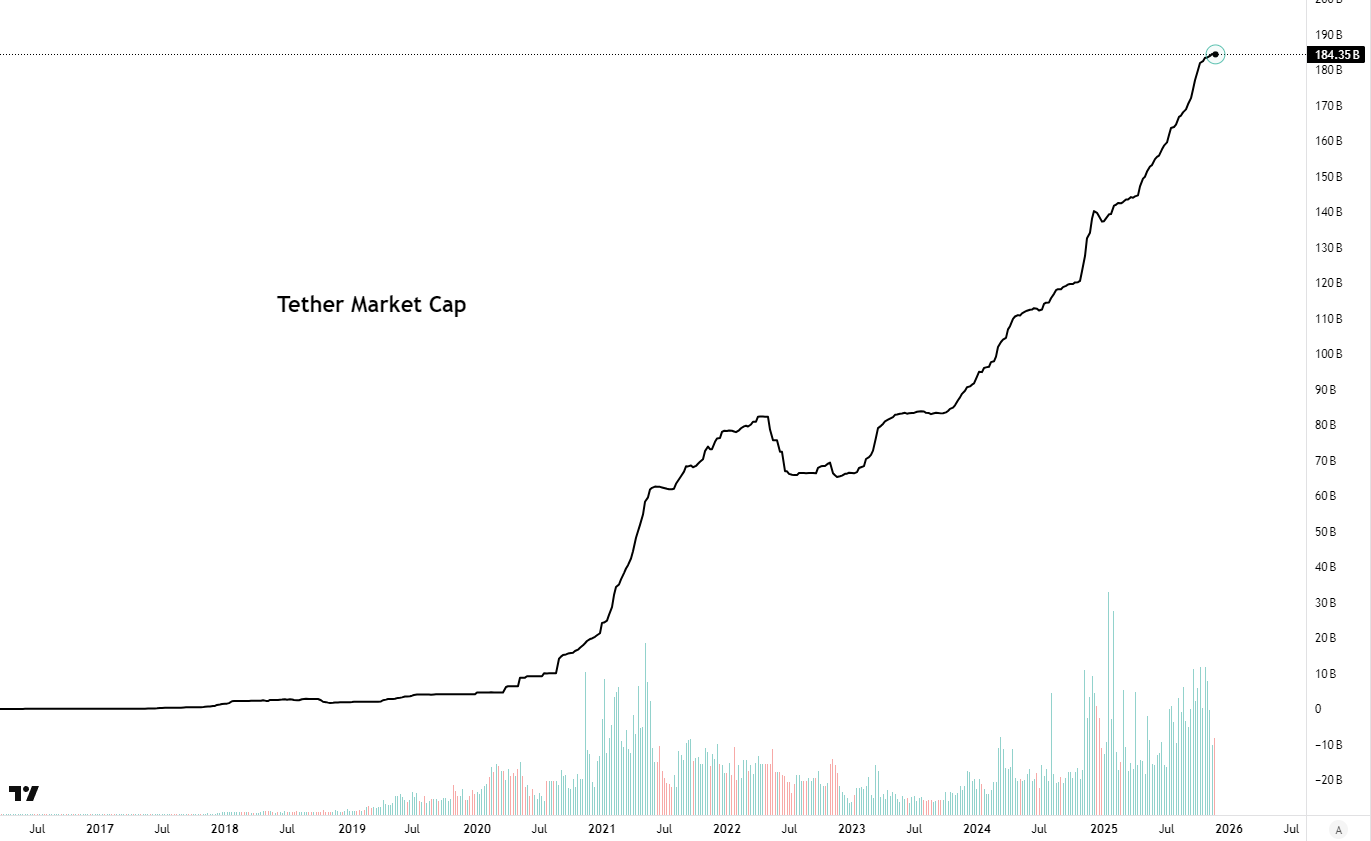
Tether Market Cap. Displayed in linear chart.
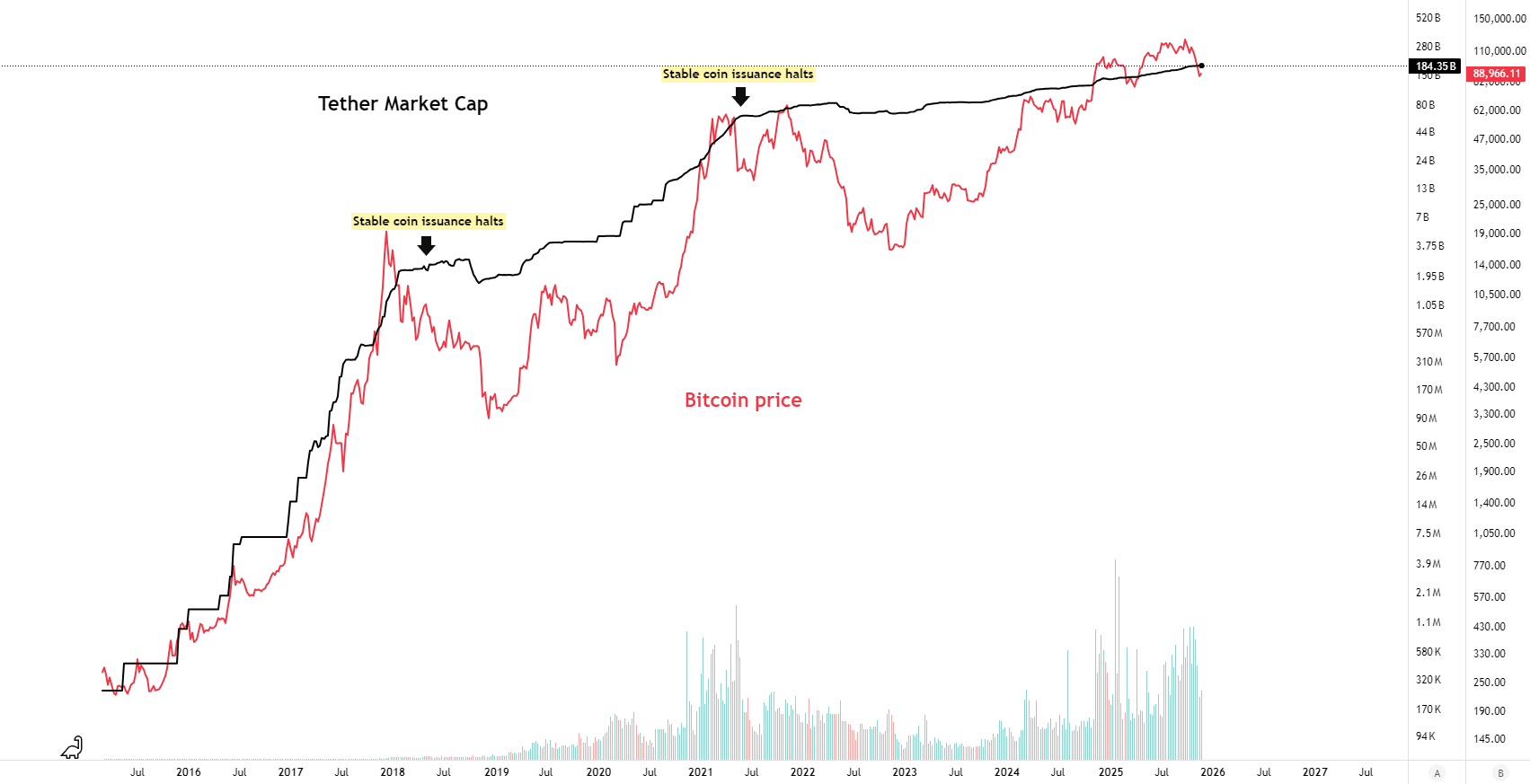
Tether Market Cap with price of Bitcoin. Displayed in log chart.
Now, conversely, if USDT were to stagnate or shrink, that’s like shadow QT (quantitative tightening). Less liquidity for crypto means less spillover into speculative stocks and ventures. This perspective underscores that macro liquidity conditions, even those originating in the opaque stablecoin world, matter a great deal for all markets. For example, consider the saga of GameStop (GME) and other meme stocks with high short interest. Those short squeeze episodes thrived in an environment of plentiful liquidity (2021’s stimulus-fueled, low-rate, high-liquidity conditions). If stablecoin growth reverses, it’s part of a broader liquidity withdrawal that gives short-sellers more “oxygen.” In other words, when money is sloshing around (including via Tether’s operations), it’s easier to ignite speculative manias and squeeze shorts. When liquidity dries up, these plays fizzle and shorts regain the upper hand. The fate of a meme stock like GME can indirectly be tied to something as arcane as Tether’s Treasury holdings — because it all feeds into the amount of risk capital in the system.
The bottom line; Crypto is not an isolated island. Its dollar flows have become an integral part of the global financial ocean. USDT’s growth has been like a stealth injection of dollars into that ocean, lifting all boats (from Bitcoin to tech stocks). And if that tide goes out, many boats risk running aground.
DeFi Has Been Re-Centralized
Here’s the blunt truth; while crypto and DeFi (decentralized finance) promised a revolution to decentralize power and trust, what we have now is almost the opposite — a recentralization. Tether, Bitfinex, and Cantor Fitzgerald (along with their aligned interests and of course the Gov) have effectively recreated a centralized bank-like structure, but with far less transparency and oversight.
The reality today is that the supposed “open, decentralized crypto economy” a theme they have stolen from the younglins, rests on U.S. debt, a single stablecoin issuer, with assets managed by (currently) a single Wall Street custodian, aligned with U.S. monetary interests and a single political-industrial faction, operating from a single friendly jurisdiction, and reliant on a single exchange’s leverage engine.
One issuer; Tether is the dominant global stablecoin issuer, and the offshore crypto economy depends on faith in Tether.
One custodian/broker; Nearly all of Tether’s reserve assets (U.S. Treasuries) are in the hands of Cantor Fitzgerald. This means one traditional finance gatekeeper is holding the keys to crypto’s biggest piggybank.
One political bloc; The nexus of power supporting this arrangement can be traced to Wall Street firms (beyond Cantor), the Lutnick/Trump network (and their allies). We have a former Cantor CEO in the U.S. Cabinet, political operatives shaping stablecoin policy, and a general alignment with an administration that has been vocal about maintaining dollar dominance through crypto.
One offshore jurisdiction; El Salvador stands out as the singular haven where this crypto cartel can operate with minimal interference. It’s the jurisdictional linchpin shielding Tether/Bitfinex from less friendly regulators.
One leverage engine; Bitfinex’s 0% Bitcoin loan program is unique. No other exchange or lender of significance is providing the kind of free leverage that Bitfinex does. It’s a one-of-a-kind liquidity pump that others now rely on indirectly.
One reserve pipeline; Practically all of the fresh money entering crypto via stablecoins flows through one pipeline — into Tether, then into U.S. Treasuries. It’s a multi-billion-dollar pipeline re-channelig crypto capital to U.S. debt.
One point of failure; This also implies a single point of failure — if Tether’s reserve access (through Cantor and the U.S. banking system) were cut off, the whole structure collapses. Likewise, if El Salvador’s shelter were compromised or if Bitfinex’s exchange went down, there are no comparable replacements ready to fill the void.
This is not decentralization by any stretch. It’s financial re-intermediation; rebuilding the same centralized structure (arguably an even more fragile one) on top of crypto. And it comes with weaker disclosures and greater systemic risk. We have effectively a cartel of insiders who now control;
The dominant global stablecoin (USDT supply and its issuance policy).
A sovereign-scale portfolio of U.S. Treasury bills. Soon crossing $200 billion.
Key infrastructure (exchange, mining investments, AI and energy projects in El Salvador).
Critical dollar flows that can move markets (via Treasury purchases or liquidations).
Cross-exchange leverage conditions (through Bitfinex’s ability to inject broadscale cheap BTC liquidity).
Onshore regulatory shaping of the stablecoin space (through USAT and political connections).
Set to prop up U.S.’ very own monetary system. Remember the new app J.P. Morgan launched, makings bonds more accesible to retail while targeting $1 trillion? The push is popping up everywhere. To no surprise, because this debt system will not survive.
In other words, crypto has been captured by the very forces it set out to overthrow. Or the very least what people believed it was set out to overthrow. A handful of players and their financial institutions have integrated crypto into their playbook. They’ve ensured that whether you approve or don’t approve of the fiat system, you are lulled in to supporting the fiat system regardless.
Belief and Psychology
Belief is a powerful phenomenon. I’ve had conversations with some of the brightest minds in the crypto and Bitcoin space — individuals one can view as prodigies — and what consistently surprises me is how limited their understanding is of the broader monetary system. It is an extraordinary contradiction; attempting to engineer a new financial architecture without a grasp of the very system it is meant to interface with.
It is not unlike constructing an impressive vessel while lacking any real understanding of the properties of water. The vessel design may be brilliant, but without comprehension of the environment in which it must operate, the design is not even close to be sufficient. All you are doing is applying severe risk for millions of people.
Ask yourself; How many of your friends have unknowingly traded U.S. government debt recently? I guess you know someone that is invested in Crypto? Perhaps you are?If you’ve ever touched USDT — even once, whether in a DeFi liquidity pool or on a centralized exchange — you have traded U.S debt. Bought Bitcoin? That means you traded U.S. debt. Opened a perpetual futures contract? That was U.S. debt, too. Used stablecoins for yield farming, exchange or liquidity? Yes, you were trading U.S. debt. Every click, every swap, every leveraged long position is synced directly to the largest unregulated money-market fund on Earth — Tether — which is funneling money into short-term U.S. Treasuries via Cantor Fitzgerald.
People still act like crypto is a separate universe — a rebel economy, an escape from Wall Street. It’s time to face reality; it’s the same universe. The borders are an illusion.
At first glance, many think they are trading Bitcoin or ETH — but really you’re trading the U.S. short-term funding market, wrapped in a token and laundered through an offshore shell. The same handful of financiers who run the old system are the ones ultimately pulling the strings in this new one. There aren’t multiple parallel financial systems; there is only One. Crypto hasn’t escaped. In fact, crypto has become a high-octane extension of it — a manipulated, turbo-charged liquidity engine. This One Financial System is not the decentralized utopia many idealists envisioned with DeFi. It’s CeFi — 100% centralized finance — wearing a decentralized mask. It’s a rigged game where, upholding the monetary system is always prioritzed before the people.
For sophisticated crypto investors, every time you press “buy,” you are ultimately reinforcing the very system you believed you had left behind. You did not escape Wall Street as the common idea suggest; rather Wall Street redirected you in to something they acted hostile against — bait triggered into a highly liquid market, a market desired by the younger generations, a market that now serves to sustain, and in many ways reinforce, the structural illness of our debt-burdened financial system.

It is worth noting that the technical details presented here are understood by only a smaller fraction of market participants and the general society. It is equally important to recognize that what you have just been made aware of is not an isolated occurrence; the underlying misconduct and deception, spans far more broadly — worldwide.
If you can’t hold it, you don’t own it.
Buckle up. The red flag is raised.
Best regards,
Corporalis Commodis,
Lasse