
$1000 oil? Eh..
Those who denominate assets in dollars, do so at their own peril.

This is not financial advice.
Errors may occur.
We are going to examine historical oil prices adjusted to 2026 dollar terms, but before turning to those figures it is worth briefly addressing a development unfolding among global refiners. Allow me to first provide a short look at the current fundamentals within the refining market affected by Hormuz.
Global refiners are beginning to step back from the market as premiums surge. At first glance this may appear bearish for oil. In reality, it reflects a structural tension in the physical market that is only beginning to surface. On the physical side, buyers of feedstock are effectively divided into two categories. The first consists of refiners and petrochemical operators running with almost no buffer. Their facilities depend on a constant inflow of crude or intermediate feedstocks. If they cannot secure supply immediately, the consequences are straightforward: operations must stop. Large refining and petrochemical complexes cannot simply pause and wait for markets to calm. This vulnerability is particularly acute for operators heavily reliant on Middle Eastern supply chains. Even a brief disruption in logistics can push them toward Force Majeure within days. Faced with that risk, they will attempt to secure feedstock at almost any price. Premiums become secondary to the need to keep plants running. If they succeed, operations continue. If they fail, Force Majeure becomes unavoidable.
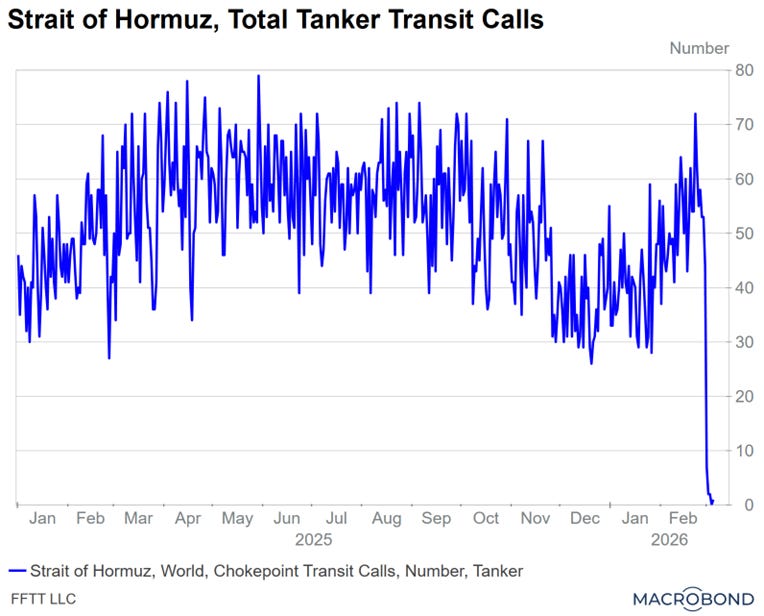
The second group consists of refiners with temporary breathing room. These operators hold inventories sufficient to maintain production for a limited period and are therefore choosing to step back from the market for now, hoping that premiums cool and conditions stabilize before they are forced to purchase again. At present it is largely the first group competing aggressively for supply, pushing premiums higher. But inventories are not solutions, only delays. As time passes, the buffers held by the second group begin to erode. Eventually they face the same decision as the first group: either shut down operations and declare Force Majeure, or return to the market and compete for whatever feedstock remains
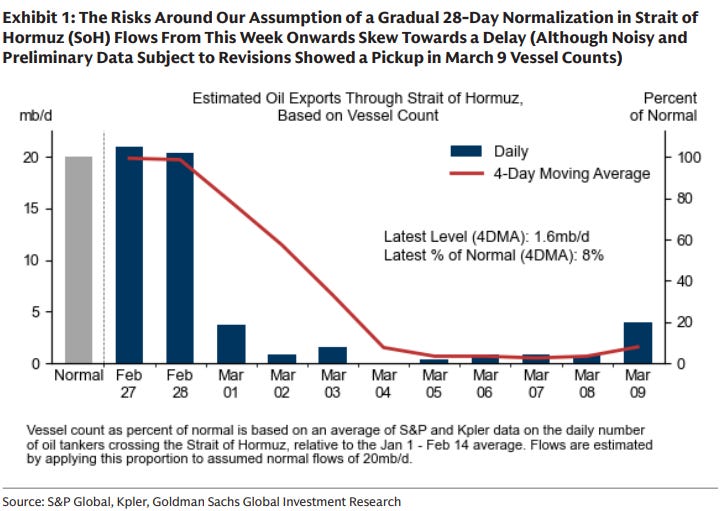
Not every refinery will simply give up and close its doors. Many will attempt to secure supply at any cost. When that moment arrives, the market dynamic changes rapidly. A larger wave of buyers suddenly competes for a limited pool of supply, sending premiums sharply higher once again. At the same time, as Force Majeure declarations accumulate across refineries and petrochemical plants, the supply of finished products to end users inevitably tightens. The next stage then unfolds with familiar brutality: product prices begin to surge. Prices can rise far enough to force demand destruction.
I thought it worthwhile to touch on the developments surrounding refiners, as it is often at moments like these that the deeper structure of the energy market begins to reveal itself. Now let’s move on to the main theme of the letter. With everything that is going on, it is worth pausing to consider what the absolute ceiling for oil look like in today’s nominal dollar terms. Considering the current market environment, marked by heightened tensions, it is a perspective well worth keeping in the back of your mind.
Which brings us to the broader theme explored in this letter.
What have we done?
What monster have we created?
From Refinery Digressions To Monetary Backbones
What emerges when historical oil prices are translated into today’s monetary terms can be deeply unsettling. When past cycle peaks are adjusted to reflect the value of the 2026 dollar, the nominal equivalents become far more extreme than most market participants would expect. All figures will be displayed further in to this letter but for now, it is enough to understand that the monetary denominator has changed so dramatically that the oil prices of previous eras look almost unrecognizable when expressed in today’s currency. Meaning, the unit used to measure prices (the dollar) has severely changed in value. Utilizing the official CPI will not provide much help. I am afraid this is junk of a data-set.
We will therefore begin with the crude oil futures chart, but viewed from a different perspective. Instead of observing oil purely in nominal dollar terms, the price has been adjusted for gold. The chart translates the oil price into dollar terms after accounting for changes in gold’s value in dollars, allowing us to observe oil relative to a more stable monetary benchmark while still visualizing prices in nominal terms, rather than simply presenting a ratio between the two assets. On the right axis you will therefore see the adjusted price expressed as dollars per barrel (/bbl).
The peak reached in 2022 (baby bull), when adjusted for gold, corresponds today to roughly $348 per barrel, assuming gold itself remains unchanged. In other words, the nominal price that investors remember from 2022 represents a far higher level once we account for the shifting value of the currency used to measure it, with gold as the proxy. Gold has been echoing that something profound is approaching on our economic doorstep, but who listened? Remember, gold often prices in monetary trouble long before it becomes visible in the M2 or debt data.
Before turning to previous cycle highs, it may be wise to reflect. If you find $350 per barrel striking, then the levels implied by previous cycles as the 2000s, 70s and 50s, when adjusted to 2026 dollars, may cause you to question reality itself. Those levels imply nominal price targets that are extraordinarily elevated. They deserve careful consideration rather than quick conclusions. You will find the adjusted prices below, measured against several monetary denominators: gold, the United States money supply, and United States public debt. The historical prices span several cycles, including the 1950s, the 1970s, the 1990 Gulf shock, and the 2000s, effectively illustrating what those oil prices would represent when expressed in today’s 2026 dollar terms.
